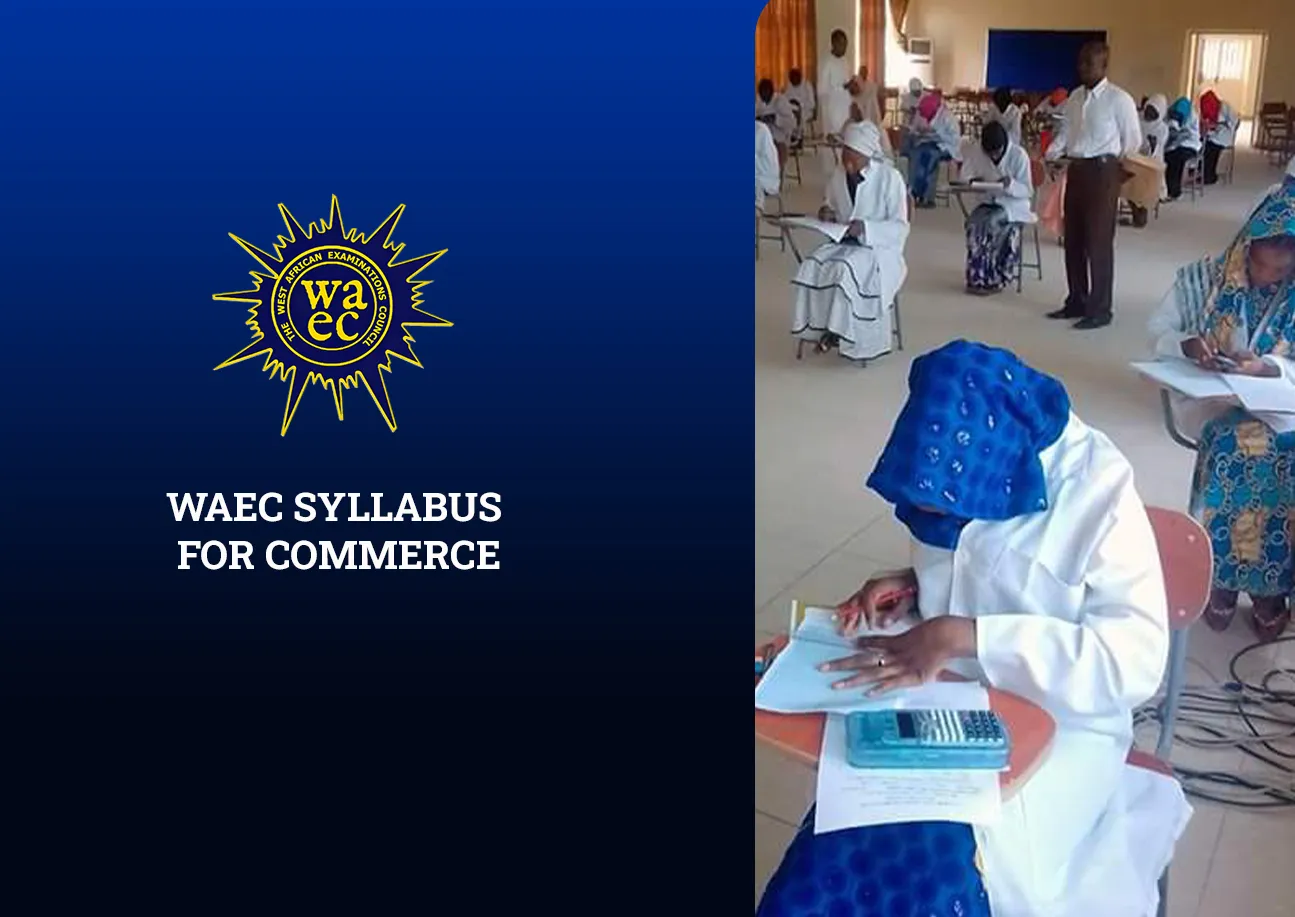
WAEC Syllabus for Commerce 2026: Complete Topics for SSCE Students
Looking for the WAEC syllabus for Commerce? Explore the full topic breakdown, learn all the topics, objectives, and recommended study areas to excel in your WAEC examination.
The West African Examinations Council (WAEC) has released the official syllabus for Commerce for the current academic session. This syllabus serves as a roadmap for students preparing for their WAEC exams and is essential for effective study planning. Candidates are advised to use this syllabus along with those of other subjects they are writing to ensure a comprehensive and focused preparation. Following the WAEC syllabus helps candidates understand the structure of the examination, key topics to study, and the types of questions they may encounter.
The Commerce syllabus is designed to cover both theoretical and practical aspects of the subject. It highlights the scope of Commerce, including business operations, trade, finance, and management principles. Candidates should use this syllabus to guide their revision, practice past questions, and strengthen areas where they feel less confident. Consistent reference to the syllabus ensures no topic is overlooked, and candidates are better prepared to answer both multiple-choice and essay questions in the exam.
Scheme of Examination
| Paper | Duration | Structure | Marks |
|---|---|---|---|
| Paper I | 50 minutes | 50 multiple-choice questions | 50 |
| Paper II | 2 hours | 8 essay questions (answer any 5) | 100 |
Detailed WAEC Commerce Syllabus
| S/N | Topics | Subtopics / Notes |
|---|---|---|
| 1 | Introduction | Definition of Commerce & E-Commerce, History/Background, Scope, Functions |
| 2 | Occupation | Meaning, Types (Industrial, Commercial, Service), Factors determining employment, Career Opportunities |
| 3 | Production | Meaning, Factors (land, labour, capital, entrepreneurship), Types (Primary, Secondary, Tertiary), Division of labour/specialization, Inter-relationship between production and exchange |
| 4 | Business Units | Meaning & Objectives, Forms of business (Sole Proprietorship, Partnership, Co-operative Societies, Credit Union, Public Enterprises, Companies), Sources of capital, Amalgamations, Mergers, Dissolution/Liquidation |
| 5 | Trade Associations | Aims & Functions: Trade Association, Chamber of Commerce, Employers Association, Consumer Association/Consumerism |
| 6 | Business Capital & Profits | Types of capital, Credit meaning & sources, Working capital, Profits & Turnover |
| 7 | Trade | Home Trade: Retail & Wholesale trade, Channel of Distribution; Foreign Trade: Import/export, Balance of trade/payment, Barriers, Tariffs, Role of Port & Airport Authorities |
| 8 | Purchase & Sale of Goods | Procedures & Documents (Order, Invoice, Credit/Debit Note, etc.), Price Quotation, Terms & Means of Payment, E-payment |
| 9 | Finance & Financial Institutions | Money (Meaning, Forms, Functions), Banks (Types & Functions), E-banking, Insurance (Types, Principles, Importance), Capital Market, Stock Exchange, Commodity Exchange |
| 10 | Transport, Tourism, Communication & Warehousing | Transport (Land, Water, Air, Pipeline), Tourism, Communication (Post Office, Courier Agencies, Computer Appreciation), Warehousing |
| 11 | Advertising | Meaning, Roles, Advantages & Disadvantages, Types, Methods, Media |
| 12 | Introduction to Marketing | Marketing Meaning, Concept, Marketing Mix (4Ps), Customer Services, Sales Promotion |
| 13 | Legal Aspects of Business | Contract, Agency, Sales of Goods Act, Hire Purchase Act, Employer/Employee Rights, Government Regulation, Consumer Protection |
| 14 | Government Policies | Commercialisation, Privatisation, Deregulation: Meaning, Advantages/Disadvantages |
| 15 | Introduction to Business Management | Meaning, Objectives, Functions, Resources, Organizational Setup, Communication, Social Responsibility |
| 16 | Economic Groupings | ECOWAS, Niger Basin Commission, Lake Chad Basin Commission, Mano-River Union, European Union, West African Clearing House (History, Membership, Objectives, Achievements, Problems) |
Recommended Textbooks
- Senior Secondary Commerce, Book One, Two, and Three – M. O. Odedokun, P. C. Udokogu, C. O. N. Oguji
- Basic Marketing – McCarthy Jerome, E., William Perreault Jr.
- Marketing – G. B. Giles
- Consumer Behaviour – Prof. Achumba (University of Lagos)
Candidates are encouraged to make full use of the WAEC past questions alongside this syllabus for effective exam preparation. This ensures familiarity with question patterns and improves performance.
For other subjects’ syllabuses, check our dedicated pages to get complete guidance for your WAEC exams.